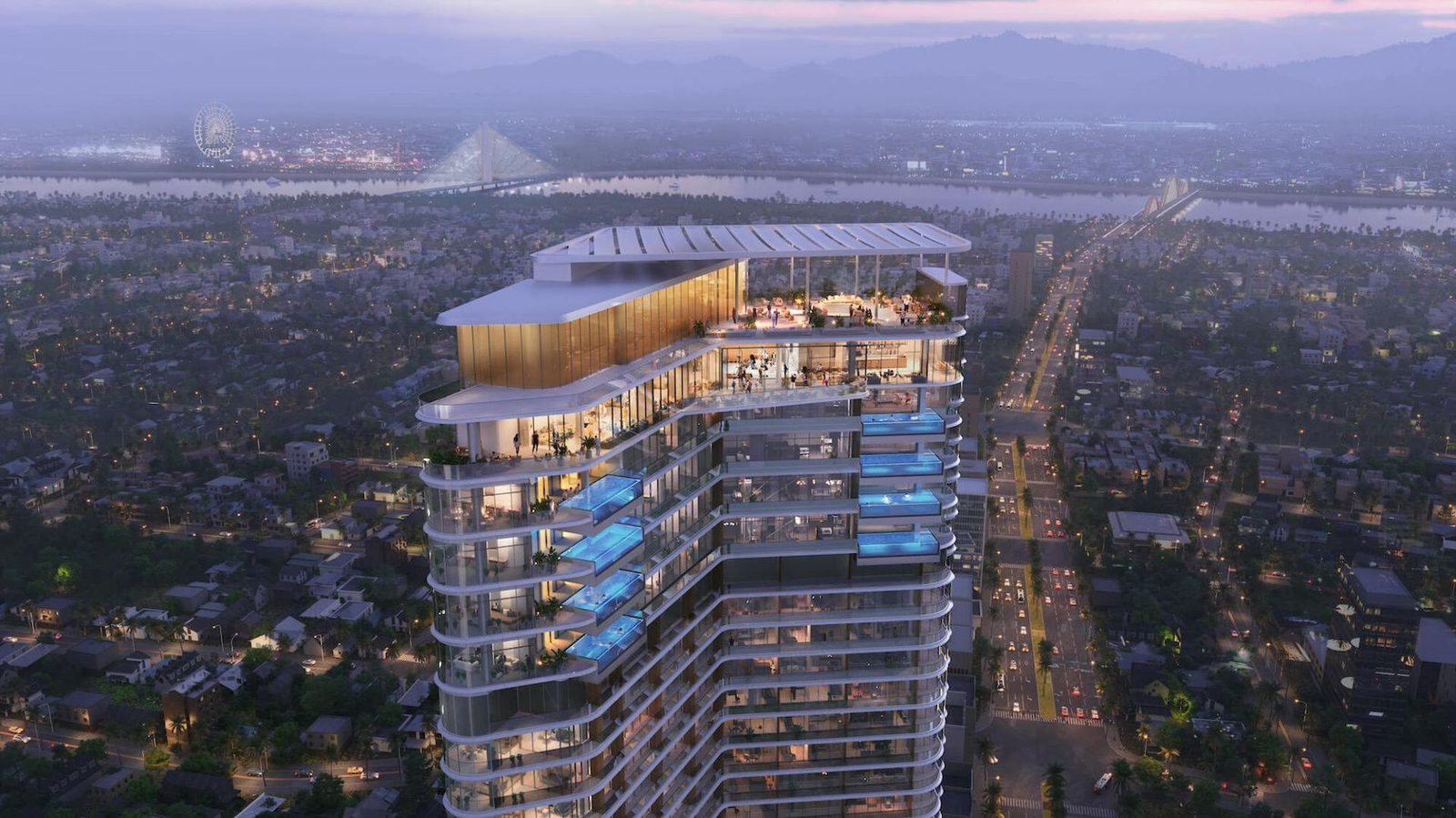
 Photo: Nobu Residences Da Nang — Brand Atlas
12 September 2026 ·6 min read
Branded Residences in Vietnam: Big Pipeline, Hard Rules, Real Opportunity

Vietnam's luxury property story is unusual. A fast-growing domestic wealthy class, a long and genuinely beautiful coastline, and tourism infrastructure built at extraordinary speed produced a wave of condotel and resort-residential development in the 2010s. Much of it disappointed: guaranteed-return products failed, some pink books never issued, and buyer trust took a serious hit.
The market that has emerged since is more disciplined and, for a well-capitalised sponsor, considerably more interesting. International brands have returned, the legal framework has been substantially revised, and the domestic buyer has become far more demanding about who is building and who is operating.
Where the market actually is
- Ho Chi Minh City — Districts 1, 2 (Thu Thiem) and Binh Thanh. The deepest urban wealth pool in the country and the strongest branded-tower absorption, driven by domestic buyers and Viet Kieu returnees.
- Hanoi — Ba Dinh, Tay Ho and the emerging western corridor. More conservative, more state-adjacent wealth, strong appetite for large-format branded apartments.
- Da Nang and Hoi An — the country's principal resort-branded market: beachfront towers and low-rise villa schemes serving both domestic second-home demand and, increasingly, regional buyers.
- Phu Quoc — island resort product with a visa-friendly tourism frame and the most volatile track record in the country; excellent when masterplanned, poor when not.
- Nha Trang, Cam Ranh and Ha Long — resort corridors with strong tourism fundamentals and an uneven development history, where brand affiliation is doing genuine work in rebuilding buyer trust.
The rules that decide who can buy
Foreign ownership in Vietnam is workable but bounded, and every sales plan must be built around the limits rather than around hope:
- 01Fifty-year leasehold, renewable. Foreign individuals acquire a 50-year term on apartments and houses, extendable on application. Vietnamese nationals and foreign spouses of Vietnamese nationals can hold longer-term rights.
- 02The 30% rule. Foreigners may own no more than 30% of apartments in a single building, and there are ward-level caps on landed houses. In a scheme priced for international buyers, this is a hard ceiling on offshore absorption.
- 03The pink book. The ownership certificate is the point at which the transaction becomes real. Delays in issuance — historically the market's deepest wound — remain the item buyers' counsel examines first.
- 04Land use rights, not land. All land is ultimately state-held; the developer holds land use rights whose term, permitted use and payment status determine whether the project can legally sell. Diligence here is non-negotiable.
- 05Sale conditions and bank guarantees. Off-plan sale requires the project to meet statutory conditions including a bank guarantee for buyer obligations. Sponsors who market before qualifying create enforcement exposure that brands will not accept.
| Segment | Typical positioning | Indicative premium vs comparable unbranded |
|---|---|---|
| Ho Chi Minh City prime | Hotel-attached and branded towers | 25-45% |
| Hanoi prime | Branded apartments, large format | 20-35% |
| Da Nang beachfront | Resort-attached towers and villas | 25-45% |
| Phu Quoc (masterplanned) | Resort villas with rental programmes | 20-40% |
| Nha Trang / Cam Ranh | Resort-attached, recovering market | 15-30% |
Why the premium exists: it is buying trust
This is the analytical heart of the Vietnamese market. In Singapore the brand competes at the margin against already-excellent unbranded product. In Vietnam the brand is solving a counterparty problem: will this building be finished, will the pink book issue, will the pool still be clean in year five, and will the management company still exist?
An international operator with reputational exposure is the closest thing the market has to a warranty. That is why hotel-attached schemes outperform licence-only ones by a wide margin here, and why brand affiliation can compress the sales period from years to months for an otherwise comparable building.
It also sets the sponsor's obligation clearly: if the operating model, the service charge and the sinking fund are not genuinely funded, the brand's presence is a promise the building cannot keep — and Vietnamese buyers now check. See our note on [de-branding risk](/news/branded-residence-de-branding-risk-2026) for what happens when that promise fails.
Which brands are transacting
The active set skews towards global hotel groups with an existing Vietnamese operating footprint — the Marriott luxury brands, Accor's upper tiers, Hyatt, IHG's luxury portfolio, Rosewood, Regent and Nobu — alongside a growing group of design and lifestyle affiliations in Ho Chi Minh City. Domestic conglomerates increasingly partner with these brands rather than compete with them, which has improved standards across the board.
Selection here should weight three things unusually heavily: whether the brand already operates a hotel in the city (staffing and distribution), whether its residential team has managed a Vietnamese handover before, and whether the licence's termination provisions would survive a sponsor refinancing. See [how developers select a hospitality brand partner](/news/how-developers-select-hospitality-brand-partner).
What sponsors get wrong in Vietnam
- Repeating the guaranteed-return era. Fixed rental guarantees funded from sales proceeds destroyed the condotel segment. Any income proposition must be underwritten by real operating performance.
- Selling to foreigners past the quota. Marketing plans that assume 60% offshore absorption in a building capped at 30% are a structural failure, not a sales problem.
- Treating approvals as sequential formality. Investment registration, land allocation, 1/500 planning approval, construction permit and sale eligibility each have real failure modes and long timelines.
- Under-specifying the MEP and the envelope. Vietnam's humidity and typhoon exposure punish brand-standard specifications designed for drier climates; the retrofit lands on the service charge.
- Skipping the service-charge conversation. Domestic buyers benchmark against ordinary condominium fees. A hotel-standard charge needs to be justified with a demonstrated service scope before contract, not after.
The capital picture
Vietnamese development has been financed heavily through domestic bank credit, corporate bonds and pre-sales — a mix that proved fragile during the 2022-23 bond stress, when several large developers restructured. The consequence for 2026 is a clear bifurcation: sponsors with clean land positions and institutional partners are financing well, while others are seeking joint-venture equity from Singaporean, Japanese, Korean and Hong Kong platforms that are actively looking for Vietnamese exposure.
For international capital, the workable route remains a JV with a local sponsor that holds clean land use rights, with governance, reporting and completion protections documented to international standard. The brand licence is increasingly part of that negotiation, because a bankable licence improves the debt terms.
Outlook to 2030
Three things are likely. Legal reform continues to bed in, gradually improving title certainty and, with it, foreign participation. Da Nang consolidates as the country's branded resort capital, with the strongest operator cluster outside the two big cities. And quality separation accelerates: schemes with real operators and funded service models will resell at a visible premium to the improvised stock of the last cycle, which is exactly the evidence the market needs to mature.
Vietnam rewards patience and punishes shortcuts more reliably than any other market in Southeast Asia.
Frequently Asked Questions
Can foreigners buy branded residences in Vietnam?
Yes, on a 50-year renewable leasehold basis, subject to a cap of 30% of the apartments in any single building and ward-level limits on landed houses. Vietnamese nationals, and foreign spouses of Vietnamese nationals, can hold longer-term rights.
What is a pink book in Vietnam?
The pink book is the certificate of land use rights and ownership of assets attached to land — the document that evidences a buyer's ownership. Historic delays in issuance are the single biggest source of buyer distrust in Vietnamese resort property, and timing should be examined in diligence.
Why did Vietnam's condotel market fail?
Because guaranteed rental returns were frequently funded from sales proceeds rather than from operating performance, and because many schemes could not deliver ownership certificates. When sales slowed, the guarantees stopped. Any modern income proposition should be underwritten by real hotel-operating economics.
Which Vietnamese city is best for branded residences?
Ho Chi Minh City has the deepest urban demand and the strongest branded-tower absorption; Da Nang is the leading resort-branded market with the best operator cluster. Hanoi is more conservative but absorbs large-format branded apartments well.
See also
Market guides by country
- 'The Future of Branded Residences' — Global Tour 2026
- Branded Residence Ownership Structures Explained: The 2026 Guide
- Hotel-Branded vs Design-Branded Residences: The 2026 Comparison
- What Are Branded Residences? 2026 Definition, Models and Market Size
- Trustworthy Branded Residence Brands in 2026: How to Judge Credibility