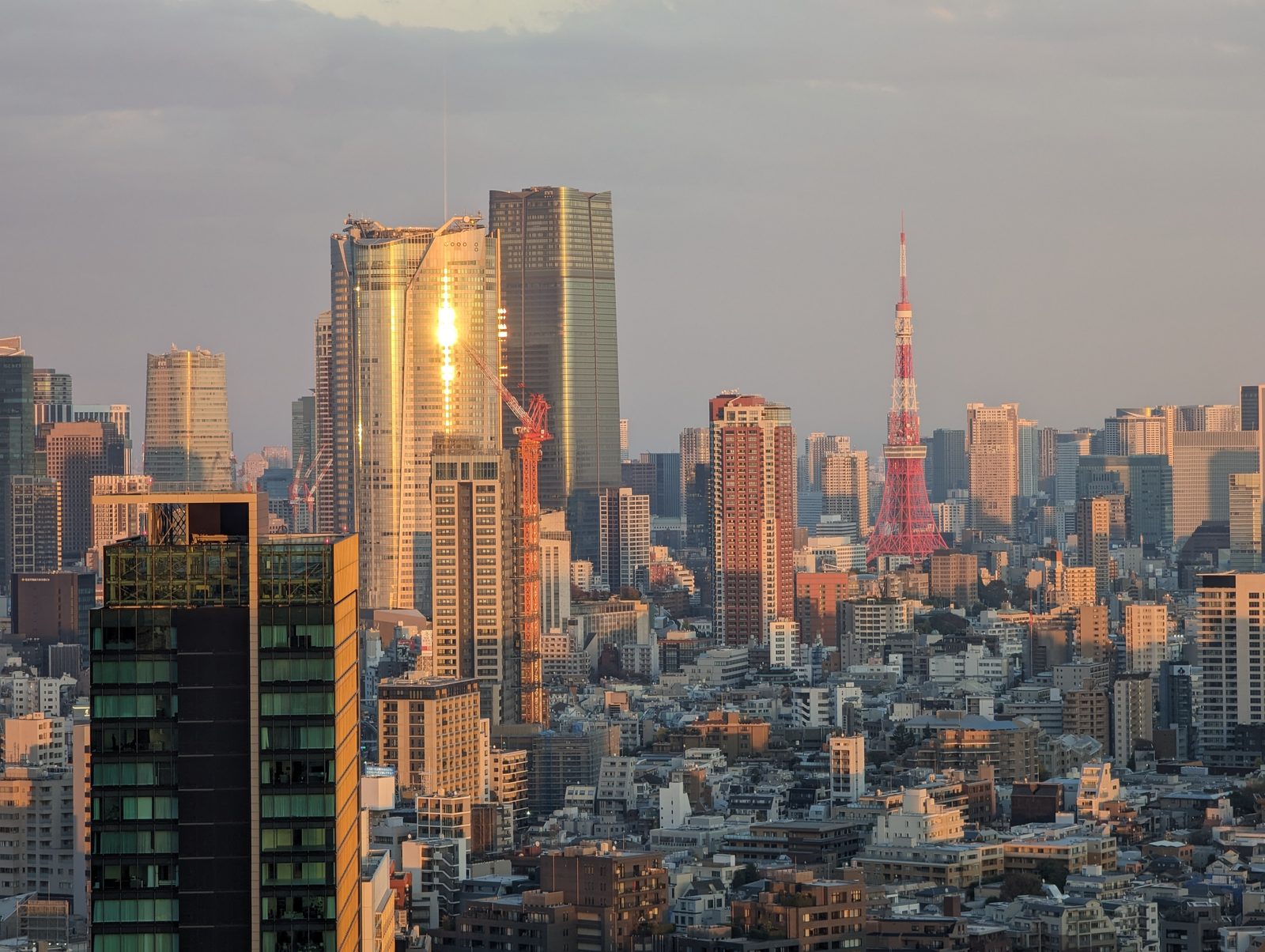
 Photo: Roppongi, Azabudai Hills and Tokyo Tower, Minato City, Tokyo
14 September 2026 ·6 min read
Branded Residences in Japan: Tokyo, Kyoto, Niseko and the Freehold Advantage

Japanese prime residential was, for thirty years, a domestic market that international capital largely ignored. Three things changed it: currency, tourism and supply. The yen's depreciation made Tokyo prime property dramatically cheaper in dollar terms than Hong Kong, Singapore, Sydney or New York. Inbound tourism reached record levels and normalised Japan as a second-home destination. And a generation of large-scale redevelopment — Azabudai Hills, Toranomon, Yaesu, Nihonbashi — finally produced buildings specified to international luxury standards.
Where the market actually is
- Central Tokyo (Minato, Chiyoda, Shibuya) — Azabudai, Roppongi, Akasaka, Hiroo, Omotesando and Toranomon. Branded and hotel-attached towers with genuine amenity depth, the deepest buyer pool and the best liquidity in the country.
- Niseko and Hakuba — Japan's international resort market, dominated by ski-season demand from Australia, Singapore, Hong Kong and increasingly Greater China. Strongly rental-driven, with an established operating sector.
- Kyoto — small, tightly regulated, machiya-conscious, and the country's most design-constrained luxury market. Height limits and landscape ordinances mean product is rare and rarity is the thesis.
- Osaka — improving rapidly on the back of redevelopment and the integrated-resort investment cycle; a secondary but real branded market.
- Okinawa and emerging resort markets — early-stage resort-branded product with a domestic-plus-Asian buyer base.
Why Japan's ownership regime is a genuine competitive advantage
Across Asia, foreign buyers navigate leaseholds, quotas, additional stamp duties, nominee structures and approval committees. In Japan, a non-resident foreigner can purchase freehold land and buildings outright, register title at the Legal Affairs Bureau, and resell to anyone. There is no citizenship requirement, no residency requirement and no foreign-buyer surcharge.
This matters commercially for three reasons: the buyer pool for a Tokyo branded scheme is genuinely global; exit liquidity does not depend on a regulatory regime staying friendly; and the legal structuring costs that consume budget elsewhere in Asia simply do not arise.
What buyers should understand is that openness is not the same as absence of cost. Japan taxes holding and transfer rather than entry:
- 01Acquisition — real estate acquisition tax, registration and licence tax, stamp duty and consumption tax on the building portion of new-build purchases.
- 02Annual holding — fixed asset tax and city planning tax on the assessed value, payable every year regardless of use or occupancy.
- 03Income and exit — rental income is taxable in Japan, and capital gains on a disposal within five years are taxed at a materially higher rate than after five years. That five-year line shapes hold periods more than any market view.
- 04Inheritance — Japan's inheritance tax regime can reach non-resident owners depending on circumstances and is the single most under-advised issue for foreign buyers of Japanese property.
| Segment | Typical positioning | Indicative premium vs comparable unbranded |
|---|---|---|
| Central Tokyo prime | Hotel-attached and branded towers | 20-40% |
| Niseko / Hakuba | Resort-branded with rental programmes | 25-45% |
| Kyoto | Scarcity-constrained boutique and heritage | 30-55% |
| Osaka | Urban branded, emerging | 15-25% |
What the brand actually adds in Japan
Japanese construction quality is excellent and Japanese service culture is, by global consensus, unmatched. So what is the brand for?
Four things, and they are specific. International specification — ceiling heights, unit sizes, primary-suite proportions and kitchen formats in conventional Japanese luxury stock are frequently unsuited to an international buyer. Amenity depth — Japanese condominiums traditionally offer very little; branded schemes bring spa, pool, residents' dining, concierge and wellness. English-language operating capability — a genuine differentiator for non-resident owners managing a property remotely. And rental distribution in resort markets, where an operator's booking platform materially outperforms independent letting.
Where the brand adds least is basic reliability, which Japan already provides. Sponsors who pitch a Japanese scheme primarily on trust are solving a problem the market does not have.
Which brands are transacting
Japan's branded residential set is led by the ultra-luxury hotel operators with existing Tokyo footprints — Aman and its Janu sibling, Mandarin Oriental, Bulgari, Four Seasons, Ritz-Carlton, Park Hyatt-adjacent operators and Peninsula-tier hoteliers — usually inside large mixed-use redevelopments delivered by the major Japanese developers. In Niseko the set is different: resort operators and international lifestyle brands with real property-management platforms.
The structural feature that foreign sponsors must understand is that Japan's prime development market is dominated by a small number of very large domestic developers who control the best sites through long-term assembly. International participation is overwhelmingly through partnership rather than through independent land acquisition.
What sponsors get wrong in Japan
- Assuming land can be assembled quickly. Site assembly in central Tokyo takes years and depends on relationships and patience that cannot be bought at speed.
- Importing unit mixes. Japanese regulatory floor-area calculations, balcony treatment and structural requirements for seismic performance change what is buildable; brand standards must be reconciled with them at concept stage.
- Under-planning seismic and MEP integration. Base isolation, structural damping and the resulting service-void requirements are not optional and affect ceiling heights, which in turn affect brand standard compliance.
- Ignoring the management association. Japanese condominium law and the kanri kumiai structure determine how an operator accesses common areas and how charges are levied. The operating agreement has to fit that framework.
- Treating Niseko as Tokyo. Resort economics, seasonality, foreign-buyer concentration and rental dependency make Niseko an entirely different underwriting exercise.
The capital picture
Japan remains the developed world's cheapest financing market, with very low nominal borrowing costs for qualifying sponsors — a structural advantage that has drawn substantial international capital into Japanese real estate since 2023. For residential-for-sale development, the practical route for foreign capital is a joint venture with an established Japanese developer or a partnership with a domestic asset manager, using an appropriate vehicle structure with careful attention to Japanese tax on distributions.
The weak yen cuts both ways: it makes Japanese assets cheap to acquire in dollar terms and it makes imported brand-standard FF&E and MEP equipment expensive to procure. Sponsors should hedge the procurement side deliberately rather than assume the currency remains favourable through delivery.
Outlook to 2030
Expect three developments. Tokyo's branded stock deepens as the remaining major redevelopment sites complete, creating for the first time a real branded resale market with comparable evidence. Niseko institutionalises, with operator consolidation and better owner reporting. And regional cities enter the conversation — Osaka on the back of its investment cycle, Fukuoka and Sapporo on the back of domestic migration and tourism.
Japan is unlikely to become a volume branded market. It is already one of the highest-quality ones.
Frequently Asked Questions
Can foreigners buy property in Japan?
Yes, with no restrictions. Non-resident foreigners can buy freehold land and buildings in Japan on the same terms as Japanese nationals, with no permit, quota, residency requirement or foreign-buyer surcharge. Title is registered at the Legal Affairs Bureau and the property can be resold to any buyer.
What taxes apply to branded residences in Japan?
Acquisition tax, registration and licence tax, stamp duty and consumption tax on the building element at purchase; annual fixed asset tax and city planning tax while holding; income tax on rental income; and capital gains tax at a higher rate on disposals within five years of acquisition. Inheritance tax can also reach foreign owners depending on circumstances.
Where are Japan's branded residences located?
Primarily central Tokyo — Minato, Chiyoda and Shibuya wards, including Azabudai, Roppongi, Akasaka and Toranomon — plus the Niseko and Hakuba ski markets, a small and tightly regulated Kyoto segment, and an emerging Osaka market.
Are Japanese branded residences a good rental investment?
In Niseko and Hakuba, resort rental programmes can be productive because the season is concentrated and operator distribution is strong. In Tokyo, yields are compressed and the investment case rests on capital preservation, currency and scarcity of internationally specified stock rather than on income.
See also
Market guides by country
- 'The Future of Branded Residences' — Global Tour 2026
- Branded Residence Ownership Structures Explained: The 2026 Guide
- Hotel-Branded vs Design-Branded Residences: The 2026 Comparison
- What Are Branded Residences? 2026 Definition, Models and Market Size
- Trustworthy Branded Residence Brands in 2026: How to Judge Credibility