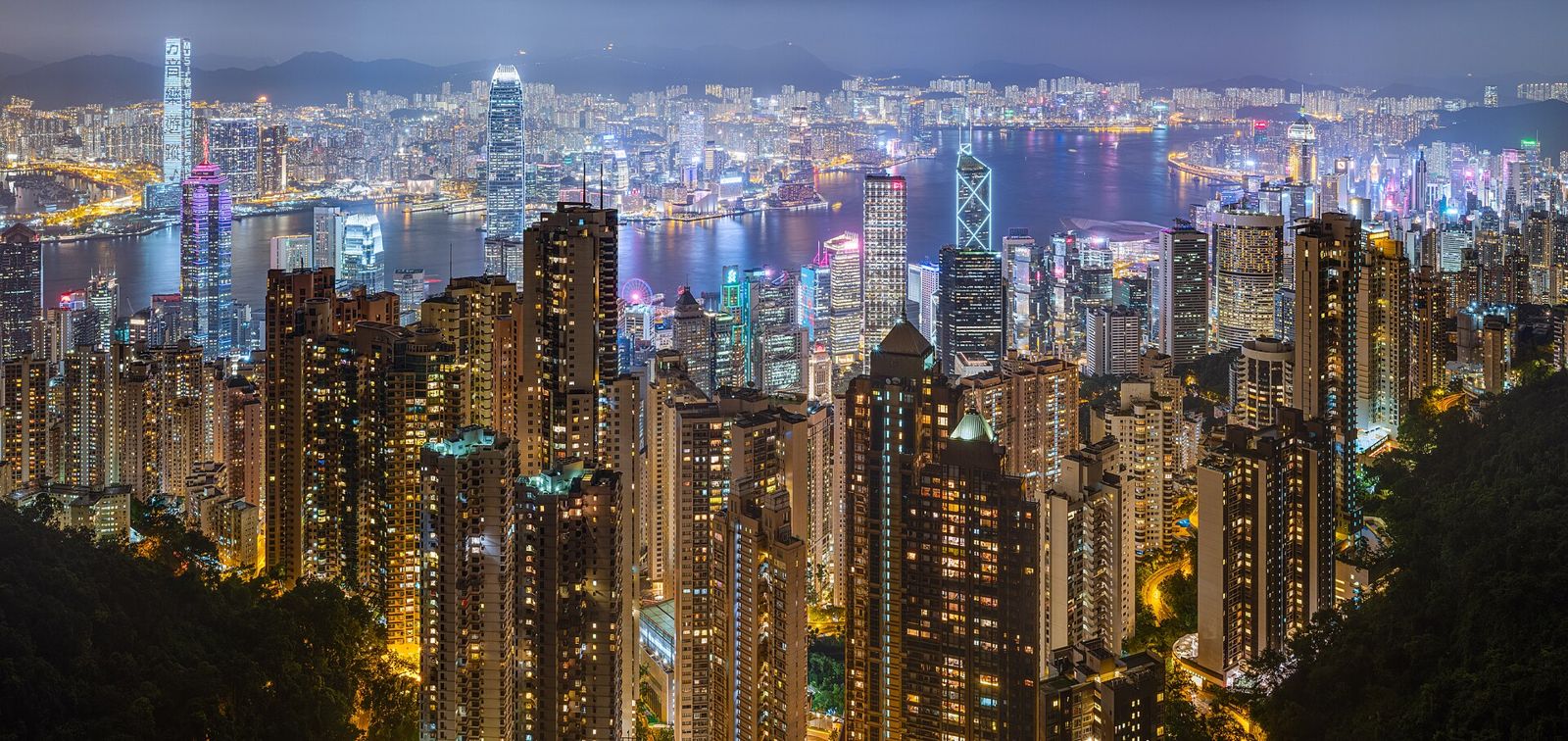
 Photo: Victoria Harbour, Hong Kong
25 August 2026 ·5 min read
Branded Residences in Hong Kong: Repricing, Rebuilding and the Return of Quality Demand

Hong Kong remains one of the most expensive residential markets on earth, but it is a different market from the one that peaked in 2021. Prices across the luxury segment fell substantially, transaction volumes thinned, and the government removed the Special Stamp Duty, Buyer's Stamp Duty and New Residential Stamp Duty regime in early 2024 to restore liquidity.
What followed was not a uniform recovery. It was a widening gap between prime, well-managed, genuinely scarce assets and the large volume of ordinary luxury stock. Branded residences sit firmly on the right side of that divide.
Where the market actually is
- The Peak, Mid-Levels and Southside (Repulse Bay, Deep Water Bay) — the traditional ultra-prime districts, dominated by low-density and heritage-scale product.
- West Kowloon and Kai Tak — the government's designated growth corridors, with harbour-front towers, the arts district and improving transport making them the most active new-build luxury locations.
- Central and Admiralty — hotel-attached serviced apartment and residence product serving executives, family offices and corporate lets.
- Discovery Bay and outlying low-density pockets — a small resort-adjacent segment, largely domestic.
Why branded product suits a polarised market
In a correcting market, buyers stop buying floor area and start buying reasons. A branded residence supplies four of them: professional management that protects the asset over decades, an amenity and service platform that a standalone building cannot replicate, an identifiable resale story, and — in Hong Kong specifically — a rental proposition for the corporate and expatriate leasing market, where serviced, branded stock commands the strongest rents in the city.
That last point is under-appreciated. Hong Kong has an unusually deep corporate housing market. A residence that can be let on a serviced basis to a bank, a law firm or a relocating executive has an income floor that pure owner-occupier product does not.
| Segment | Typical positioning | Indicative premium vs comparable unbranded |
|---|---|---|
| The Peak / Southside | Ultra-prime low density | 15-30% |
| West Kowloon / Kai Tak | Harbour-front branded towers | 15-25% |
| Central / Admiralty | Hotel-attached serviced residences | 20-35% |
| Outlying low density | Resort-adjacent schemes | 10-20% |
The structural constraints
- 01Land is allocated, not simply bought. Government land sales, lease modification premiums and redevelopment of existing leases are the routes to a site. Each has a distinct timeline and cost profile, and the lease modification premium negotiation can move a feasibility by a wide margin.
- 02Gross floor area concessions govern amenity. Hong Kong's GFA rules determine how much of a brand's required amenity programme can be built without consuming saleable area. Brand standards written for Dubai floorplates need rationalising for Hong Kong efficiency ratios.
- 03Deed of mutual covenant. The DMC is the instrument through which the operator's rights, the service charge and the shared facilities are enforced. It must be drafted in parallel with the licence agreement.
- 04Construction cost and programme. Hong Kong is among the most expensive construction markets globally. Brand-standard specification uplift needs to be underwritten against a premium that, while healthy, is not unlimited.
- 05Mainland demand is policy-sensitive. Cross-border buying is a meaningful part of the luxury bid and it responds quickly to policy and capital-flow conditions on both sides of the border. Underwrite it as a cyclical, not a structural, source of absorption.
Which brands work here
Hong Kong buyers are among the most brand-literate in the world and are unimpressed by affiliation for its own sake. The brands that transact are those with an operating presence and a service reputation the buyer has personally experienced — the Mandarin Oriental, Four Seasons, Rosewood, St. Regis and Peninsula tier — alongside high-end serviced residence operators that dominate the corporate leasing segment.
Fashion and automotive brand licences, which generate launch attention in emerging markets, have limited traction here. The buyer asks what the affiliation does, not what it says.
What sponsors get wrong
- Assuming the correction means cheap entry. Prime land in Hong Kong repriced far less than headline residential indices, and lease premiums remain substantial.
- Designing amenity that GFA rules will not accommodate, then value-engineering out the very facilities the brand licence requires.
- Modelling mainland demand as a constant. It is a swing factor, not a base case.
- Ignoring the leasing market. In Hong Kong, a scheme with a credible serviced-lease strategy has a materially better risk profile than one relying solely on sales absorption.
- Treating the DMC as a post-completion legal exercise. It determines whether the operating model is enforceable for the life of the building.
The capital picture
Hong Kong development capital is dominated by the major local family-controlled developers, mainland groups with a Hong Kong presence, and institutional joint ventures. Bank appetite for luxury residential development tightened through the correction and remains selective, favouring sponsors with strong balance sheets and pre-committed exit strategies.
For international sponsors, the realistic route is a joint venture with a local partner that can manage the land, lease and approvals process. Capital advisory work here is as much about structuring the partnership and the exit as it is about raising the equity.
Outlook to 2030
Hong Kong will not return to the speculative volume of the last cycle, and that is a healthier basis for branded product. Expect continued polarisation towards quality, growth in hotel-attached and serviced branded stock driven by the corporate leasing bid, and steady delivery in Kai Tak and West Kowloon as the government's growth corridors mature. Sponsors that build genuinely differentiated, well-managed assets will find a buyer base that has become extremely good at telling the difference.
Frequently Asked Questions
Has Hong Kong's property market recovered?
Partially and unevenly. Following a deep correction and the removal of buyer stamp duties in 2024, transaction volumes improved and prime, scarce assets stabilised first. Ordinary luxury stock has recovered far less. The market is now quality-selective rather than broadly rising, which favours branded and well-managed schemes.
Do foreigners pay extra stamp duty in Hong Kong?
The Buyer's Stamp Duty, New Residential Stamp Duty and Special Stamp Duty regime was removed in early 2024, so non-permanent-resident and non-local buyers no longer pay the additional duties that previously applied. Standard ad valorem stamp duty still applies, and buyers should take current advice as policy in Hong Kong can change quickly.
Where are Hong Kong's branded residences located?
Principally The Peak, Mid-Levels and the Southside for ultra-prime low-density product; Central and Admiralty for hotel-attached serviced residences; and West Kowloon and Kai Tak for new harbour-front branded towers in the government's designated growth corridors.
Why do serviced branded residences perform well in Hong Kong?
Because Hong Kong has an unusually deep corporate and expatriate leasing market. Branded serviced stock commands the strongest rents in the city, which gives owners an income floor that pure owner-occupier product lacks and makes the asset more financeable.
See also
Market guides by country
- 'The Future of Branded Residences' — Global Tour 2026
- What Are Branded Residences? The Definitive 2026 Guide
- Branded Residence Ownership Structures Explained: The 2026 Guide
- Hotel-Branded vs Design-Branded Residences: The 2026 Comparison
- What Are Branded Residences? 2026 Definition, Models and Market Size