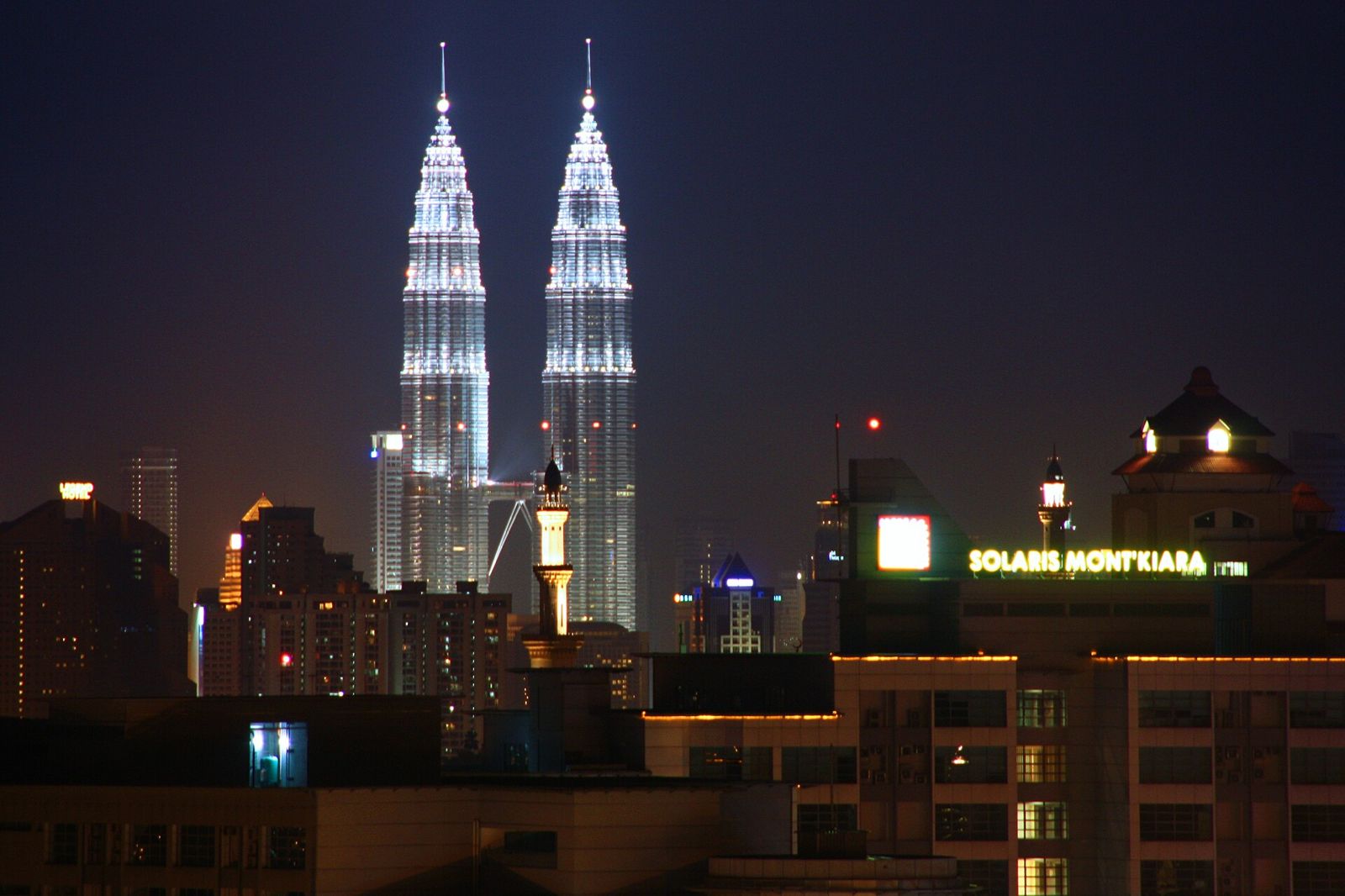
 Photo: Kuala Lumpur skyline with the Petronas Towers
27 August 2026 ·5 min read
Branded Residences in Malaysia: Value, Visas and the Kuala Lumpur Oversupply Question

Malaysia has quietly built one of the region's most substantial branded residence stocks. Kuala Lumpur City Centre alone hosts multiple internationally branded towers, and the resort markets of Langkawi, Penang and Desaru have added hospitality-attached villa product.
The country's appeal to buyers is straightforward: sophisticated infrastructure, English-language business environment, freehold tenure, permitted foreign ownership, and prime pricing that can be a fraction of comparable Singapore product an hour away.
Where the market actually is
- Kuala Lumpur City Centre and Bukit Bintang — the core branded tower market, clustered around the Petronas Towers, TRX and the Golden Triangle.
- Tun Razak Exchange (TRX) — the financial district masterplan, with the strongest institutional-quality new supply and the clearest place-making story.
- Mont Kiara and Damansara Heights — established expatriate and affluent domestic residential districts, lower-rise and family-oriented.
- Penang — heritage George Town plus island resort product, with a distinct and loyal buyer base.
- Langkawi and Desaru — resort-branded villa and residence schemes attached to international hotels.
- Johor / Iskandar — proximity to Singapore and the Johor-Singapore Special Economic Zone create a genuine structural story, tempered by a history of oversupply.
The oversupply problem, stated honestly
Malaysia's property overhang — completed but unsold residential units — has been a policy concern for years, concentrated in high-rise condominium stock in Kuala Lumpur, Johor and Penang. Any sponsor considering a KL tower must confront this directly.
The distinction that matters is between undifferentiated stock and genuinely scarce product. The overhang is overwhelmingly concentrated in mid-market and investor-grade high-rise units of similar specification. Prime, large-format, service-led product in the best locations behaves differently and has continued to transact. A branded scheme succeeds here only if it is unambiguously on the scarce side of that line: superior location, superior floorplates, a real service platform and a unit mix aimed at end-users rather than yield-chasing investors.
| Segment | Typical positioning | Indicative premium vs comparable unbranded |
|---|---|---|
| KLCC / Bukit Bintang | Branded high-rise towers | 20-35% |
| TRX | Masterplan-integrated branded | 20-30% |
| Mont Kiara / Damansara Heights | Low-rise family branded | 15-25% |
| Penang | Heritage and island resort | 15-30% |
| Langkawi / Desaru | Resort-attached villas | 25-40% |
Ownership, thresholds and the visa question
Foreigners may own freehold and leasehold residential property in Malaysia subject to state-level minimum purchase price thresholds, which vary materially between states and are periodically revised. Consent from the relevant state authority is required, and certain categories — Malay reserved land, and units allocated under Bumiputera quotas — are restricted.
The Malaysia My Second Home (MM2H) programme provides a long-stay visa route with financial and, in recent iterations, property-purchase requirements, alongside state-level variants such as the Sarawak and special economic zone programmes. MM2H has been revised several times, and terms have both tightened and loosened across successive policy rounds. It is a genuine demand driver for resort and second-home product — but it should be treated as a supporting factor in the sales story, never as the underwriting case. Programmes that can change by ministerial decision do not belong in a base-case absorption model.
Which brands work here
Malaysia's branded stock is dominated by the major international hotel groups with an existing operating footprint — the Four Seasons, St. Regis, Ritz-Carlton, Banyan Tree, Regent and Como tiers in the urban market, with Banyan Tree, Anantara and similar resort operators in Langkawi and Desaru.
The commercial calculation differs from India or the Gulf. In a market with abundant supply, the brand's job is absorption velocity and buyer confidence rather than headline premium. Sponsors should test brand candidates against a simple question: which affiliation will materially shorten the sell-down period, and is the licence cost less than the carry it saves?
What sponsors get wrong
- Underwriting a KL tower on premium alone, when absorption pace is the binding constraint in an oversupplied segment.
- Building investor-grade unit mixes. Small units in KLCC are the most overbuilt product in the country. Large-format, end-user product is where the scarcity is.
- Treating MM2H as a demand guarantee. Policy has moved repeatedly; the model must survive without it.
- Missing state thresholds and consent timelines, which can delay foreign-buyer completions and disrupt cashflow forecasts.
- Applying a Singapore service charge to a Malaysian buyer base without demonstrating the value at handover.
The capital picture
Malaysian development is financed principally by domestic banks, listed property groups and government-linked investment companies, with selective participation from regional institutional capital. Islamic finance structures are well established and mainstream, and for many sponsors they are the natural funding route rather than a specialist product.
For international capital, Malaysia works best as a joint venture with an established local developer that holds the land bank and understands state-level approvals. The Johor-Singapore Special Economic Zone has renewed institutional interest in the southern corridor, though sponsors should be disciplined about a market with a long memory of over-building.
Outlook to 2030
Expect three shifts. First, resort-branded product outperforms urban high-rise as Langkawi, Desaru and Penang benefit from regional leisure demand without the oversupply overhang. Second, the Johor corridor becomes genuinely institutional if the special economic zone delivers on infrastructure and cross-border mobility. Third, KL consolidates around fewer, better schemes, as lenders and brands both become more selective about adding to an already deep supply pipeline.
Malaysia rewards sponsors who build what is scarce and punishes those who build what is abundant. The branded label does not change which side of that line a scheme sits on — the product does.
Frequently Asked Questions
Can foreigners buy property in Malaysia?
Yes. Foreigners can own freehold and leasehold residential property subject to state-level minimum purchase price thresholds and state authority consent. Malay reserved land and units allocated under Bumiputera quotas are restricted. Thresholds vary by state and are revised periodically, so current confirmation is essential before marketing to foreign buyers.
Is Kuala Lumpur oversupplied with luxury apartments?
The overhang is concentrated in undifferentiated mid-market and investor-grade high-rise stock, particularly small units. Prime, large-format, service-led product in the best locations has continued to transact. A branded scheme must be clearly on the scarce side of that divide to avoid becoming part of the overhang.
Does MM2H help sell branded residences?
It supports demand for resort and second-home product by providing a long-stay visa route, and it is a useful part of the sales story. However, MM2H terms have been revised several times, so it should never be the basis of an underwriting case — the scheme must be viable without it.
Which Malaysian markets offer the best branded residence returns?
Resort-attached villa product in Langkawi, Desaru and Penang currently shows the widest premiums, typically 25-40%, because supply is genuinely scarce and the hospitality service model is intrinsic to the product. Urban KL towers achieve solid premiums but carry greater absorption risk.
See also
Market guides by country
- 'The Future of Branded Residences' — Global Tour 2026
- What Are Branded Residences? The Definitive 2026 Guide
- Branded Residence Ownership Structures Explained: The 2026 Guide
- Hotel-Branded vs Design-Branded Residences: The 2026 Comparison
- What Are Branded Residences? 2026 Definition, Models and Market Size