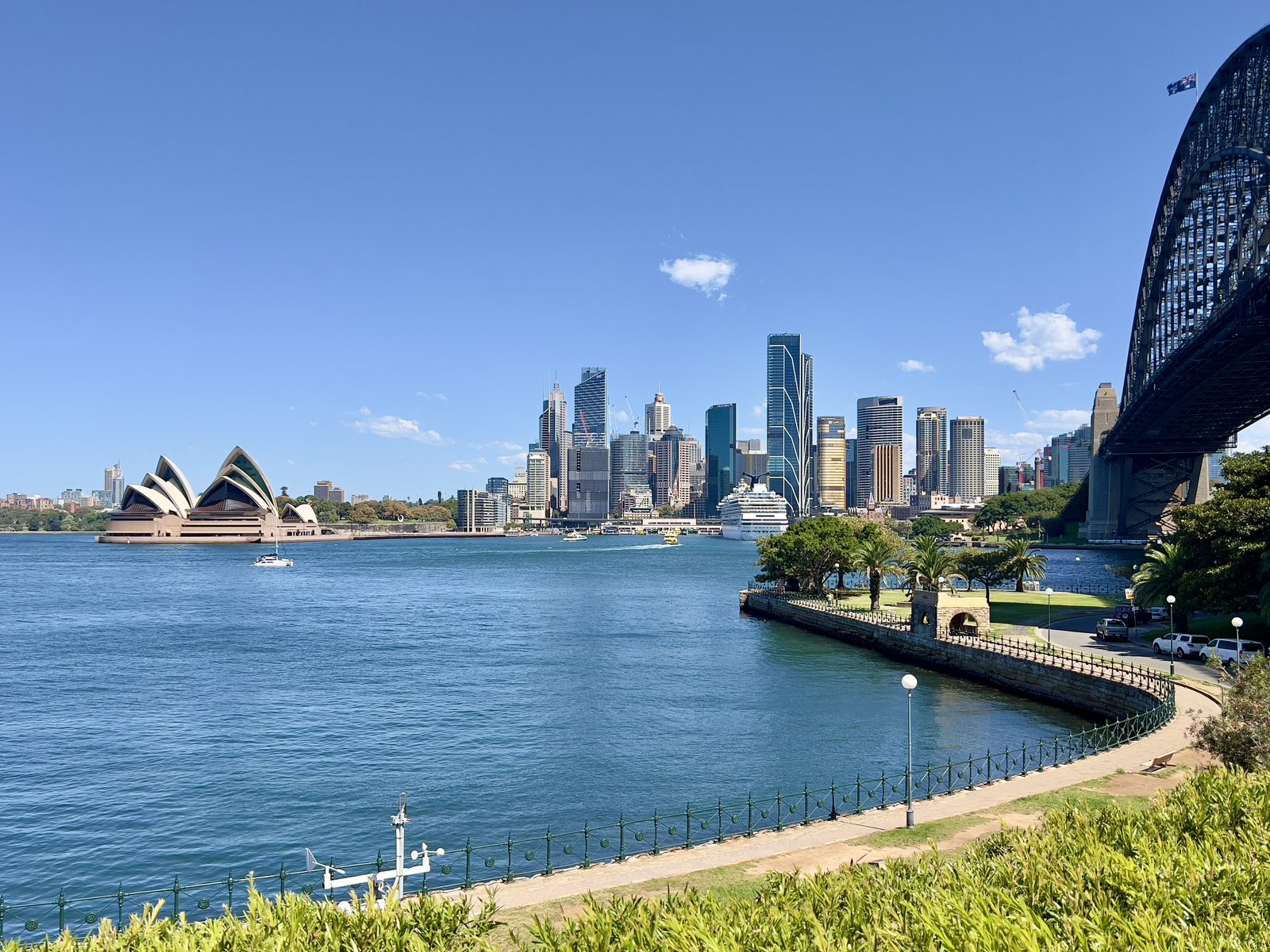
 Photo: Sydney CBD and Sydney Harbour Bridge, New South Wales
21 September 2026 ·6 min read
Branded Residences in Australia: Sydney, the Gold Coast and a Market Just Getting Started

The Australian luxury apartment market has an unusual demand profile. Elsewhere, branded buyers are international investors and second-home owners. In Australia the core buyer is a domestic owner-occupier, typically 55 to 75, selling a large family home in an established suburb and buying a serviced apartment in the same city. That single fact reshapes unit mix, amenity programming and marketing.
Where the market actually is
- Sydney — the deepest market. CBD, the harbour fringe, and the eastern and lower north shore suburbs. Australia's highest prices per square metre and the strongest case for hotel-attached branded product.
- Gold Coast (Surfers Paradise, Main Beach, Broadbeach, Burleigh) — the most active branded market by volume, driven by interstate migration and a beachfront tower tradition that already understands amenity-led living.
- Melbourne — a large luxury market with a strong design culture; branded delivery has lagged its potential and is now catching up.
- Brisbane — reshaped by the 2032 Olympic investment cycle and sustained interstate migration; the fastest-improving fundamentals in the country.
- Perth, Adelaide and resort markets (Byron Bay, Noosa, Whitsundays) — smaller, more specialised, and where lifestyle and wellness brands fit better than large hotel groups.
The rules foreign buyers and sponsors must understand
- 01FIRB approval. Foreign persons need Foreign Investment Review Board approval to acquire Australian residential real estate, with application fees that scale with property value.
- 02New dwellings only, generally. Foreign non-residents are typically restricted to new dwellings and, in defined circumstances, vacant land for development; established dwellings are largely off-limits. Temporary residents have narrower permissions tied to their residence.
- 03Foreign buyer surcharges. States apply additional stamp duty surcharges — commonly in the high single digits — plus annual land tax surcharges and, in some states, vacancy charges. Layered together these materially change a non-resident buyer's total cost.
- 04Developer new-dwelling exemption certificates. Sponsors can obtain a certificate allowing sales to foreign buyers within a development up to a defined share, which is the practical mechanism for marketing a new branded scheme offshore.
- 05Strata law. Australian schemes sit under state strata legislation, and the owners' corporation holds real power over common property and budgets. The building management and operator agreements must be drafted to survive strata scrutiny, including statutory limits on long-term management contracts in some states.
| Segment | Typical positioning | Indicative premium vs comparable unbranded |
|---|---|---|
| Sydney prime | Hotel-attached and branded towers | 20-35% |
| Gold Coast beachfront | Branded and amenity-led towers | 15-30% |
| Melbourne prime | Urban branded and design-led | 15-30% |
| Brisbane | Emerging branded, Olympic cycle | 10-25% |
| Resort (Byron, Noosa, Whitsundays) | Lifestyle and wellness affiliations | 20-40% |
Why Australia has been slow — and why that is changing
Three brakes held the market back. Construction cost and builder insolvency made complex, high-specification buildings difficult to price and risky to procure through the 2020s. Planning friction in Sydney and Melbourne made tall, amenity-rich schemes slow. And foreign buyer surcharges removed the offshore demand that seeds branded markets elsewhere.
What has changed is the domestic buyer. Decades of house price growth have created a very large cohort of equity-rich downsizers who want the service proposition and will pay for it, and who are not deterred by service charges that would stall an investor-led market. Combined with a rising development pipeline on the Gold Coast and in Brisbane, that is finally producing the volume the market needs to establish comparable evidence.
The corollary is a design brief that differs sharply from Dubai or Miami: larger apartments, fewer of them, generous storage, real kitchens, guest accommodation and car provision. A Gulf-specified unit mix will not sell in Sydney.
Which brands work here
The delivered and pipeline set spans global hotel luxury — Ritz-Carlton, Waldorf Astoria, Mandarin Oriental, Rosewood-tier operators and the Marriott and Accor luxury portfolios — alongside strong domestic and regional hospitality names and, in resort markets, wellness and lifestyle affiliations. Australian buyers are less brand-deferential than Gulf or Asian buyers; they interrogate what the brand actually provides.
That makes the service scope the centre of the pitch. Concierge, security, valet, housekeeping on demand, residents' dining, wellness and a genuinely staffed lobby are what justify the premium — see our guide to [branded residence amenities](/news/branded-residence-amenities-2026) and to the [service charges](/news/branded-residence-service-charges-2026) that fund them.
What sponsors get wrong in Australia
- Importing an investor unit mix. One and two-bedroom investor stock does not serve the downsizer, who is the buyer.
- Under-costing construction and procurement risk. Builder capacity, insolvency exposure and cost escalation remain the largest single threat to Australian delivery, and fixed-price certainty comes at a price that must be in the feasibility from day one.
- Ignoring strata constraints on management contracts. Long-term operator agreements interact with state strata legislation in ways that can shorten or expose the term. Draft for the jurisdiction, not the template.
- Treating the Gold Coast as a discount Sydney. It is a distinct market with its own buyer, its own seasonality and its own tower typology.
- Underestimating sustainability and disclosure requirements. NABERS, NCC energy provisions and state disclosure regimes affect specification, and retrofitting compliance is far more expensive than designing for it.
The capital picture
Australian residential development is financed by major and non-bank lenders with strict pre-sale coverage requirements — typically a substantial share of debt covered by qualifying pre-sales before drawdown. That makes early absorption a financing gate, not just a commercial preference, and it is precisely where a brand earns its fee: a credible brand accelerates the pre-sale run rate that unlocks construction funding.
Equity comes from domestic developers, listed platforms, superannuation-adjacent capital and increasingly Asian and Middle Eastern joint-venture partners attracted by Australia's stability and population growth. Foreign capital on the development side faces a far lighter regime than foreign buyers on the purchase side — an asymmetry worth structuring around.
Outlook to 2030
Expect Brisbane to be the standout, carried by the Olympic infrastructure cycle and migration; the Gold Coast to keep producing the most branded volume; Sydney to set the price records; and the first genuine Australian branded resale evidence to appear, which will do more to establish the category locally than any new launch. Australia is roughly where Dubai was fifteen years ago on branded penetration, with considerably more wealth per capita. That gap is the opportunity.
Frequently Asked Questions
Can foreigners buy branded residences in Australia?
Yes, with Foreign Investment Review Board approval, and generally only new dwellings rather than established homes. State foreign buyer stamp duty surcharges and annual land tax surcharges apply on top of standard costs, which materially affects a non-resident buyer's total outlay.
Where are Australia's branded residences?
Mainly Sydney, the Gold Coast, Melbourne and, increasingly, Brisbane, with a smaller lifestyle and wellness-branded segment in resort markets such as Byron Bay, Noosa and the Whitsundays.
Who buys branded residences in Australia?
Predominantly domestic owner-occupiers — equity-rich downsizers, typically aged 55 to 75, selling a large family home and buying a serviced apartment in the same city. That shapes the product towards larger apartments, real kitchens, storage, guest accommodation and car provision.
Why does Australia have so few branded residences?
Construction cost inflation and builder insolvency risk, complex state planning processes, and foreign buyer surcharges that suppressed the offshore demand which seeds branded markets elsewhere. Domestic downsizer demand is now large enough to carry the category without offshore buyers.
See also
Market guides by country
- 'The Future of Branded Residences' — Global Tour 2026
- Branded Residence Ownership Structures Explained: The 2026 Guide
- Hotel-Branded vs Design-Branded Residences: The 2026 Comparison
- What Are Branded Residences? 2026 Definition, Models and Market Size
- Trustworthy Branded Residence Brands in 2026: How to Judge Credibility