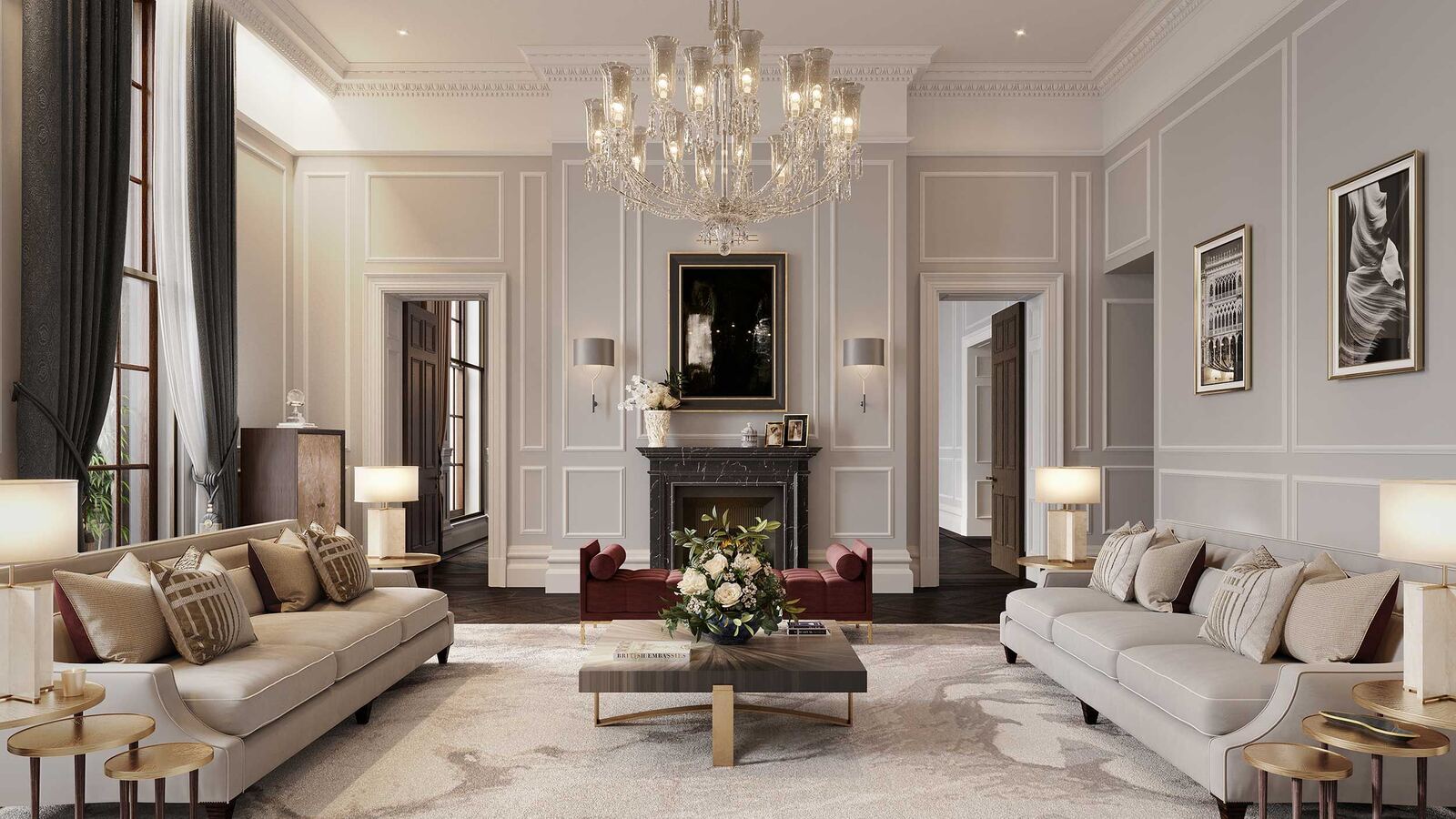
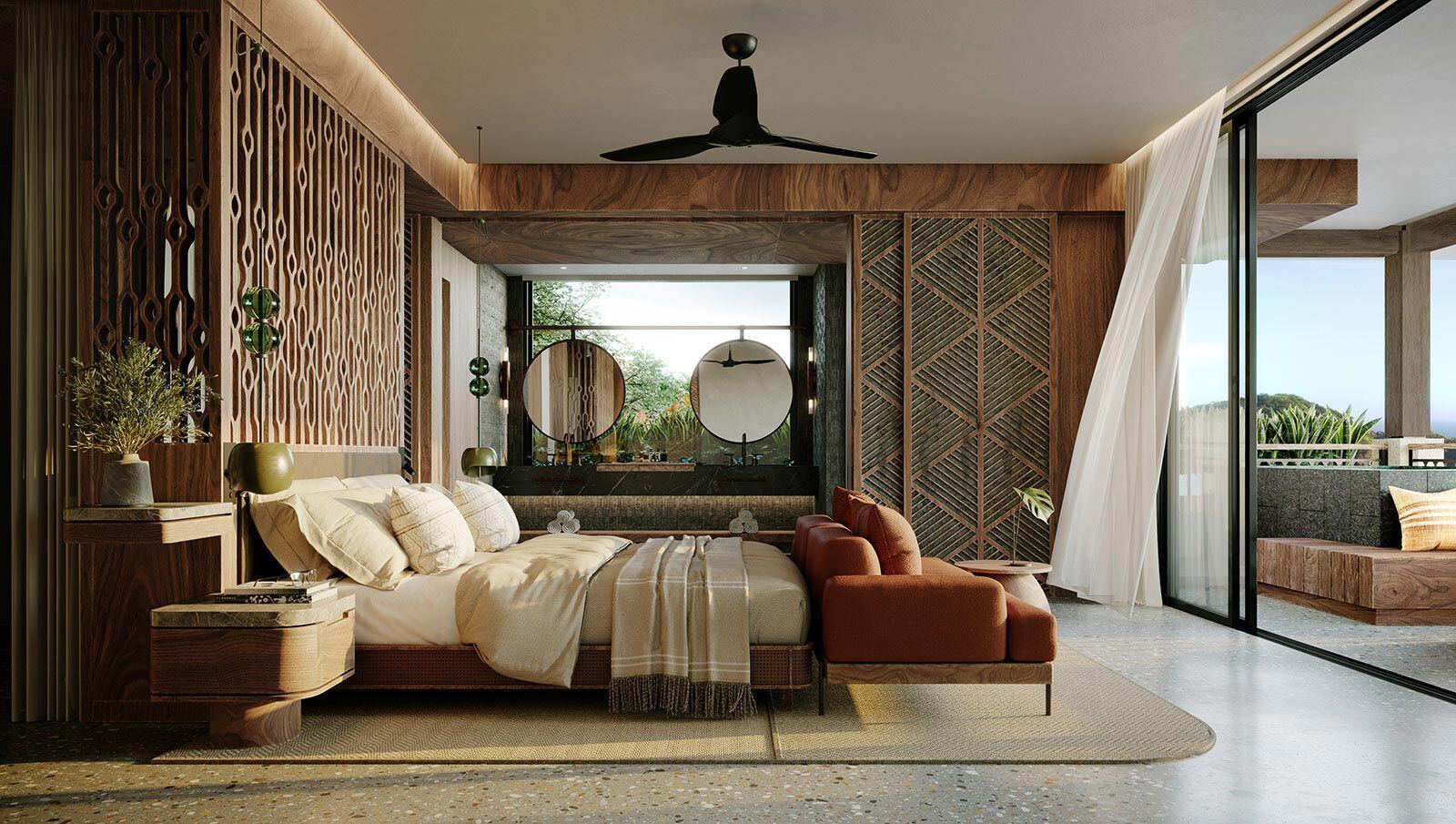
 Photo: The Ritz-Carlton Residences Costa Rica — guest house interior. Brand Atlas
6 September 2026 ·4 min read
Branded Residence Service Charges: What Owners Actually Pay

Service charges are where the branded promise meets the annual bank statement. They are also the least standardised, least disclosed and most misunderstood number in the category.
Benchmarks
| Scheme type | Annual service charge | Notes |
|---|---|---|
| Prime unbranded comparator | USD 6–12 per sq ft | Baseline facilities management, concierge desk |
| Standalone branded residential | USD 12–20 per sq ft | Enhanced concierge, security, maintenance, reserves |
| Hotel-integrated branded | USD 20–35 per sq ft | Shared amenity allocation, hotel staffing ratios |
| Resort branded villas | USD 15–30 per sq ft | Landscaping, pools, seasonality, remoteness |
| Ultra-prime trophy schemes | USD 35–60+ per sq ft | Butler service, very low staff-to-unit ratios |
What is inside the charge
- Staffing — typically 45–60% of the total. Concierge, security, engineering, housekeeping of common areas, residence management. In hotel-integrated schemes, an allocation of shared department cost.
- Operator management fee — 8–12% of the operating budget.
- Utilities for common areas and amenities — 10–20%, and rising fastest of any line in Europe.
- Planned and reactive maintenance — 10–15%.
- Insurance — 3–8%, materially higher in coastal and cyclone-exposed markets.
- Reserve fund contribution — 5–15%. Chronically underfunded across the category.
- Brand-driven costs — audit visits, training, systems and mandated supplier standards.
Why it rises after handover
Four mechanisms, all foreseeable:
- 01The developer subsidy ends. During sell-down, the developer often funds part of the budget to keep the quoted charge attractive. When the association takes over, the true cost appears.
- 02Occupancy rises. A building at 30% occupancy costs less to run than one at 90%. Launch-year budgets frequently reflect the former.
- 03Reserves come due. Hotel-standard finishes have short replacement cycles, and the first refurbishment cycle lands five to eight years in.
- 04Amenity allocation is renegotiated. Where a shared-facilities agreement allows periodic reallocation, the residential share tends to move in one direction.
A prudent buyer models the quoted launch charge plus 25–40% by year three, and asks the developer to explain why that would not happen.
What associations can control, and what they cannot
Controllable: procurement and supplier benchmarking; energy efficiency retrofits; scope of amenity hours; insurance placement; the management fee basis at renewal; staffing schedules against genuine demand patterns.
Not controllable without consequences: the contracted service standard, brand audit requirements, and the reserve contribution. Cutting these is the classic false economy — it saves a modest annual sum and puts the resale premium, which is a capital number, at risk.
The most effective cost work we see is unglamorous: a proper energy audit, a genuinely competitive re-tender of the largest three contracts, a review of amenity opening hours against usage data, and a management fee renegotiated from percentage-of-cost to a fixed indexed fee.
Questions to ask before buying
- What is the budgeted charge per square foot, line by line?
- What were the actuals for the last two years?
- Is any part of the current budget subsidised by the developer, and when does that end?
- What is the amenity cost allocation formula between hotel and residences, and can it change?
- What is the reserve fund balance and when was the last reserve study?
- Is the management fee a percentage of cost, and is it capped?
- What is the arrears rate in the building? High arrears eventually become everyone else's problem.
For developers
The service charge is a sales variable, not an afterthought. Quoting an unrealistically low charge to support a launch is the most reliable way to guarantee an angry owners' association, a service failure and a compressed resale premium within five years. Build the operating budget with the operator during design, disclose it honestly, and size the amenity offer to what the market will actually fund.
Frequently Asked Questions
How much are service charges in a branded residence?
Typically USD 12–20 per sq ft a year for standalone branded schemes and USD 20–35 for hotel-integrated ones, against USD 6–12 for comparable prime unbranded buildings. Ultra-prime trophy schemes with butler service can exceed USD 35–60 per sq ft.
Why do branded residence service charges increase after handover?
Usually because the developer's subsidy of the launch budget ends, occupancy rises, reserve contributions come due for short-cycle hotel-standard finishes, and shared amenity cost allocations are renegotiated. Modelling the launch figure plus 25–40% by year three is prudent.
What is included in a branded residence service charge?
Staffing is usually 45–60% of the total, followed by the operator's management fee at 8–12% of the budget, common-area utilities, planned and reactive maintenance, insurance, reserve fund contributions and brand-driven audit, training and systems costs.
Can owners reduce the service charge?
Yes, through procurement benchmarking, energy efficiency work, reviewing amenity hours against usage, re-tendering major contracts and renegotiating a percentage-of-cost management fee to a fixed indexed one. Cutting the contracted service standard or the reserve contribution saves little and risks the resale premium.
See also
Service, standards & running costs
- Service Standards in Branded Residences: The 2026 Benchmark
- Branded Residence Ownership Structures Explained: The 2026 Guide
- Hotel-Branded vs Design-Branded Residences: The 2026 Comparison
- What Are Branded Residences? 2026 Definition, Models and Market Size
- Trustworthy Branded Residence Brands in 2026: How to Judge Credibility