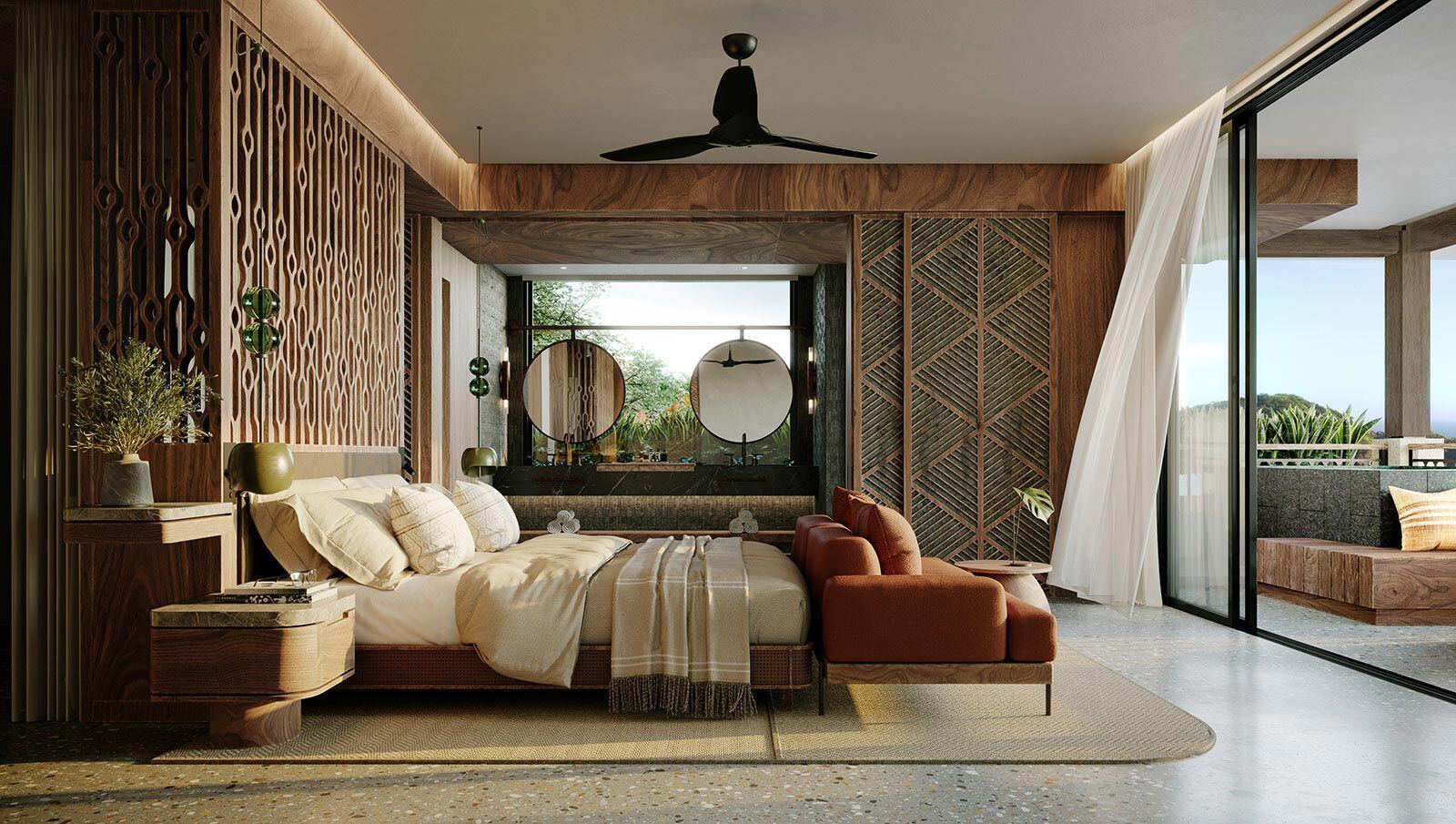
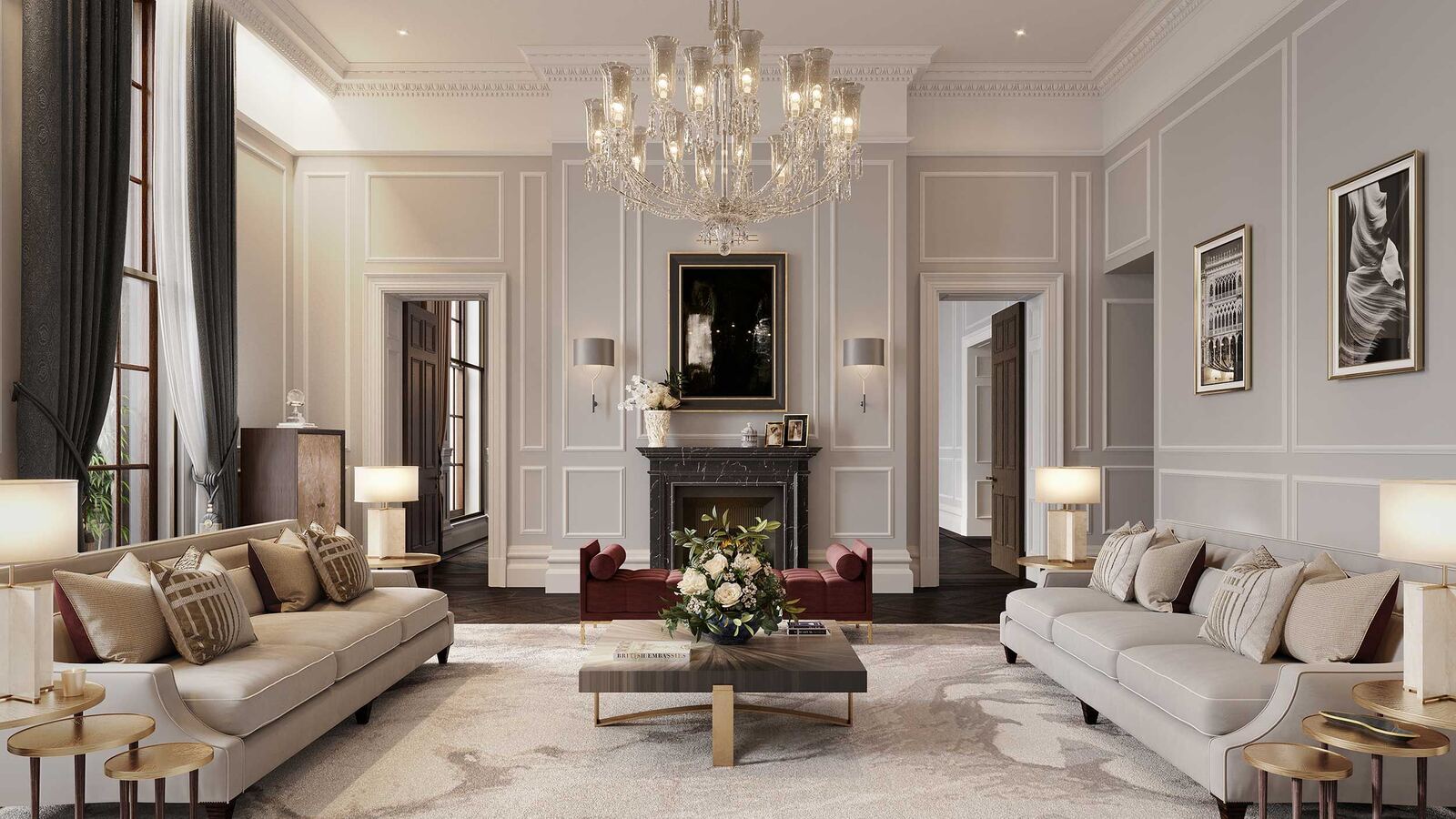
 Photo: Branded residence living room, London. Brand Atlas
2 September 2026 ·4 min read
Branded Residence Fees Explained: Licence, Management and Service Charges

Fee structures in this category are not standardised, and marketing material rarely presents them as a single picture. This piece sets out the complete stack, in the order it is incurred.
Development-stage fees (paid by the developer)
| Fee | Basis | 2026 indicative range | Recovered how |
|---|---|---|---|
| Key money | One-off at signing | USD 0.5–5m | Priced into unit sales |
| Licence / royalty | % of residential gross sales value | 3–6% | Priced into unit sales |
| Technical services | Fixed, staged across design | USD 0.5–2.5m | Development budget |
| Brand marketing contribution | % of sales value or fixed | 0.5–1.5% | Sales and marketing budget |
| Pre-opening residential services | Fixed | USD 0.3–1.5m | Development budget |
Buyers sometimes assume these costs are absorbed by the developer. They are not. They are recovered in the price per square foot, which is one reason the branded premium and the brand fee stack tend to move together — and why an unnecessarily expensive brand licence can price a scheme out of its own market.
Ownership-stage fees (paid by owners, annually)
The residential management fee
Paid to the operator for running the residential component, typically 8–12% of the residential operating budget, occasionally with an incentive element linked to service scores or budget performance. Note the incentive problem in a pure percentage-of-cost model: the operator's fee grows as costs grow. A fee floor and cap, or a fixed fee with an indexation formula, aligns interests better.
The service charge
The largest recurring cost and the number every buyer should model before exchange.
| Scheme type | 2026 indicative service charge | Principal drivers |
|---|---|---|
| Standalone branded residential | USD 12–20 per sq ft per year | Concierge, security, maintenance, reserves |
| Hotel-integrated branded | USD 20–35 per sq ft per year | Shared amenity allocation, higher staffing ratios |
| Resort branded villas | USD 15–30 per sq ft per year | Landscaping, pools, remoteness, seasonal staffing |
| Prime unbranded comparator | USD 6–12 per sq ft per year | Baseline facilities management |
The single most contested line inside the service charge is the allocation of shared amenity cost between hotel and residences. Look for an allocation formula in the association documents that is based on measurable usage or floor area rather than management discretion.
The rental programme
Optional in most well-structured schemes. The operator typically retains 30–50% of gross rental revenue, and the owner bears channel commissions, cleaning, linen, consumables and a share of programme marketing. Net-to-owner after all costs is frequently in the range of 35–50% of gross booking value — a figure that should be checked against any yield projection in the sales material.
Transfer and resale fees
Some schemes charge a resale administration or brand transfer fee, typically 0.5–2% of resale price, payable to the operator or the association. It is a small number that can become material on a short hold.
Modelling your true cost of carry
- 01Annual service charge multiplied by unit area.
- 02Plus association levies and reserve contributions if charged separately.
- 03Plus property tax, insurance and utilities where not included.
- 04Less realistic net rental income, if participating in a programme, on realistic occupancy.
- 05Then stress the service charge upwards by 25% and re-run. If the position becomes uncomfortable, the scheme is priced at the edge of affordability.
What good fee disclosure looks like
A well-run scheme provides: a line-item operating budget, prior-year actuals, the amenity allocation formula, the reserve fund study, the management fee basis, and the rental programme terms in full. Where a developer cannot provide these, the correct inference is not that the numbers are bad but that they have not been done — which is, in practice, worse.
Frequently Asked Questions
How much do branded residences cost to run each year?
In mature markets, service charges typically run USD 12–20 per sq ft per year for standalone branded schemes and USD 20–35 for hotel-integrated ones, against USD 6–12 for comparable prime unbranded buildings. On top of that sit association levies, insurance, taxes and utilities where not included.
What fees does a developer pay a brand?
Usually key money at signing, a royalty of 3–6% of residential gross sales value, a fixed technical services fee of around USD 0.5–2.5m, a marketing contribution and pre-opening services costs. Total brand cost commonly lands at 5–8% of residential gross sales value.
Who pays the brand licence fee, the developer or the buyer?
The developer pays it contractually, but it is recovered in the price per square foot, so economically the buyer funds it. That is why an over-priced licence can push a scheme beyond what its market will support.
How much does the operator take from rental income?
Typically 30–50% of gross rental revenue, before the owner's share of channel commissions, cleaning, linen and consumables. Net to the owner after all costs is often 35–50% of gross booking value, which should be tested against any projected yield.
See also
How the deals work
- How Do Branded Residences Work? The 2026 Operating Model Explained
- Service Standards in Branded Residences: The 2026 Benchmark
- Branded Residence Ownership Structures Explained: The 2026 Guide
- Hotel-Branded vs Design-Branded Residences: The 2026 Comparison
- What Are Branded Residences? 2026 Definition, Models and Market Size