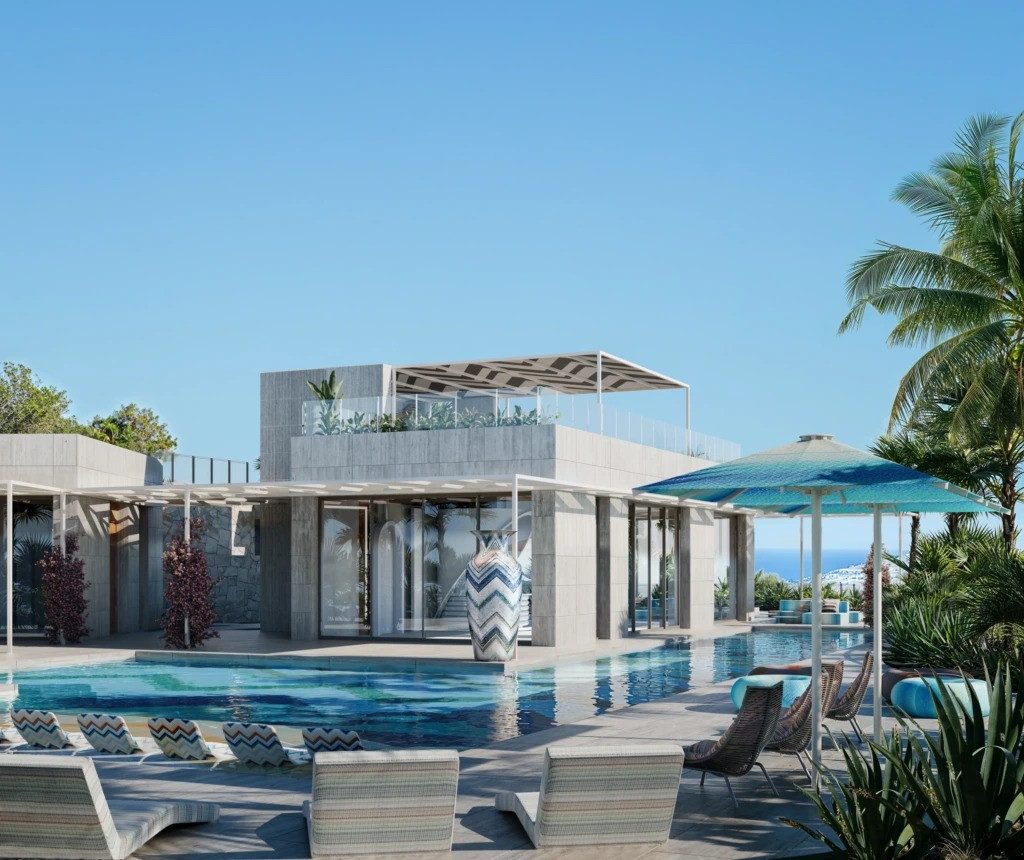
 Photo: Pullman Residences Batumi, Black Sea coast — Brand Atlas
14 September 2026 ·5 min read
Branded Residences in Georgia: Batumi, Tbilisi and the Cheapest Branded Entry in Europe

Batumi's skyline is the most unlikely branded residence cluster in Europe. A Black Sea city of under 200,000 people hosts towers carrying names from Accor, Radisson, Wyndham and Ramada, plus a steady stream of design-branded schemes. Tbilisi has added its own layer of internationally affiliated product.
This exists because of a specific policy combination: no restriction on foreign ownership of non-agricultural property, a flat and low tax regime, straightforward residency pathways for property owners, and a registration system that completes transfers in days rather than months.
Where the market actually is
- Batumi — the branded tower capital. Seafront and New Boulevard districts, aparthotel-style product sold to investors from Turkey, Israel, Central Asia, the Gulf and the former Soviet space, almost entirely underwritten on rental yield.
- Tbilisi — the more durable market. Vake, Vera, Mtatsminda and the Old Town. A genuine domestic and expatriate residential base rather than a pure investment play, with international hotel brands anchoring mixed-use schemes.
- Gudauri and the mountain corridor — ski and alpine product, short season, growing regional demand.
- Kakheti wine country — small boutique and estate product, high differentiation, thin volumes.
- Anaklia and the wider Black Sea coast — infrastructure-dependent and long-dated.
Why the premium works — and what it really means
In Batumi the branded premium is not primarily about prestige. It is about operational trust in a market with almost no institutional property management. An investor buying a €120,000 apartment from 2,000 kilometres away cannot manage it, market it or maintain it. A hotel operator can. That is the entire proposition, and it is a real one.
The consequence is that the premium attaches to the operating agreement, not the logo. Schemes where the brand licences a name but the developer's affiliate runs the rental programme deliver a fraction of the value, and the resale market has started to distinguish between the two.
Investors should also be clear-eyed about guaranteed-return offers, which are widespread in Batumi. A guarantee is only worth the balance sheet standing behind it, which is usually the developer's — not the brand's.
| Segment | Typical positioning | Indicative premium vs comparable unbranded |
|---|---|---|
| Batumi seafront towers | Branded aparthotel with rental programme | 25-35% |
| Batumi secondary districts | Design-branded apartments | 15-25% |
| Tbilisi prime | Hotel-attached branded | 20-30% |
| Gudauri mountain | Resort-attached | 15-25% |
| Kakheti boutique | Estate and wine-branded | 20-30% |
The regulatory reality: open ownership, low tax, real risk
- Foreign ownership is unrestricted for non-agricultural property, including full freehold on apartments. Agricultural land is restricted to citizens and specified entities.
- Tax is genuinely low. Property tax is minimal, rental income taxation is favourable under the small-business and individual regimes, and there is no inheritance tax. Georgia consistently ranks near the top of ease-of-doing-business measures for property registration.
- Residency is available through investment routes tied to property value thresholds, subject to periodic policy change. It should be presented accurately and never as a route to EU access — Georgia is not an EU member.
- The real risks are geopolitical and institutional. Regional security, the trajectory of EU accession politics, currency movement in the lari, and the enforceability of contracts in a young legal system are the factors that determine whether a Batumi investment performs. These belong in the underwriting, not the footnotes.
- Construction quality varies widely. Technical due diligence on the developer and the building — not just the brand — is essential.
Which brands are actually transacting
The Georgian market skews toward upper-midscale and upscale international hotel brands — Accor's portfolio including Pullman and Novotel, Radisson, Wyndham, Ramada and Best Western-affiliated product — rather than ultra-luxury. That is a rational match to the price points: a Four Seasons cost base cannot be supported at Batumi's revenue levels.
Tbilisi supports a slightly higher tier, and there is a credible gap at the genuine luxury end of the capital for an operator willing to take a long view on a market with a strong wine, food and cultural story.
For sponsors, the decisive question is not which brand, but how much of the operating platform comes with the brand. In this market, distribution, revenue management and on-the-ground operations are worth more than recognition.
What sponsors get wrong
- Selling guaranteed returns the project cannot fund. This has already damaged investor confidence in parts of Batumi and is the market's principal reputational risk.
- Licensing a name without an operator. In a market where the buyer is buying management, this is a hollow product.
- Over-supplying an identical product. Batumi's seafront has many similar towers. Differentiation by design, amenity or segment is the only defence against price competition.
- Ignoring seasonality. The Batumi season is short and concentrated. Annual yield models built on peak-month performance are wrong by a wide margin.
- Underestimating currency risk. Rents are often quoted in dollars but collected in a market whose income base is in lari. Stress-test it.
The capital picture
Georgian development is funded by sponsor equity, off-plan pre-sales and regional bank debt, with Turkish, Israeli and Gulf private capital active in equity positions. International institutional capital is largely absent, which caps exit liquidity and means sponsors should plan for a domestic or regional buyer at exit.
For investors, the practical implication is that yield is the return. Underwrite the income, discount the guarantee, and treat capital appreciation as optional upside rather than the thesis.
Outlook to 2030
Expect Tbilisi to outperform Batumi on durability as a genuine residential market with real domestic demand, while Batumi remains a higher-yield, higher-volatility investment market. Expect consolidation among operators as underperforming rental programmes are replaced. And expect the policy and geopolitical environment to remain the dominant variable — in Georgia, the macro question outranks every micro one.
Georgia is a serious market for investors who understand what they are buying: a managed yield product in a frontier jurisdiction, at a price that no European market can match.
Frequently Asked Questions
Can foreigners buy branded residences in Georgia?
Yes, without restriction on non-agricultural property, including full freehold ownership of apartments. Agricultural land is restricted. Registration is fast and inexpensive compared with most European markets.
Are Batumi branded residences a good investment?
They are a yield product rather than a capital-appreciation play. The value comes from professional rental management in a market with little institutional property management. Guaranteed-return offers should be assessed against the developer's balance sheet, not the brand's, and seasonality and geopolitical risk belong in the underwriting.
Which brands operate branded residences in Georgia?
Mainly upscale and upper-midscale international hotel brands — Accor's Pullman and Novotel, Radisson, Wyndham and Ramada-affiliated schemes — concentrated in Batumi, with a slightly higher tier in Tbilisi.
Does buying property in Georgia give residency?
Investment-linked residency routes tied to property value thresholds have been available, subject to periodic policy change. Georgia is not an EU member, so this does not confer EU rights, and current requirements should be verified before purchase.
See also
Market guides by country
- 'The Future of Branded Residences' — Global Tour 2026
- Branded Residence Ownership Structures Explained: The 2026 Guide
- Hotel-Branded vs Design-Branded Residences: The 2026 Comparison
- What Are Branded Residences? 2026 Definition, Models and Market Size
- Trustworthy Branded Residence Brands in 2026: How to Judge Credibility