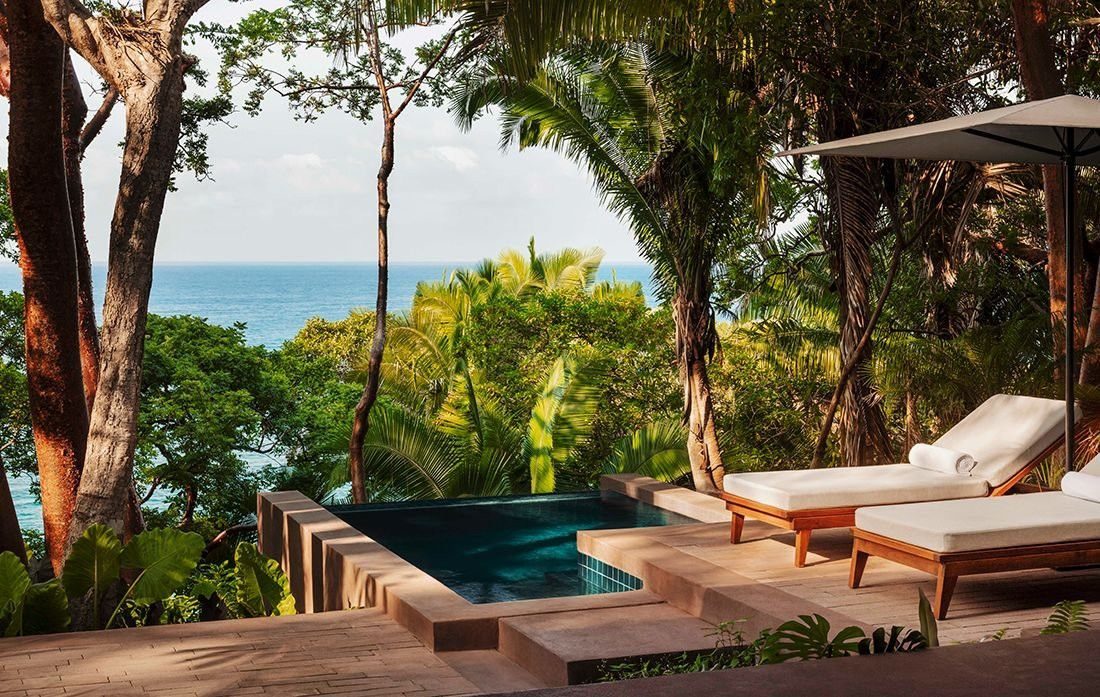
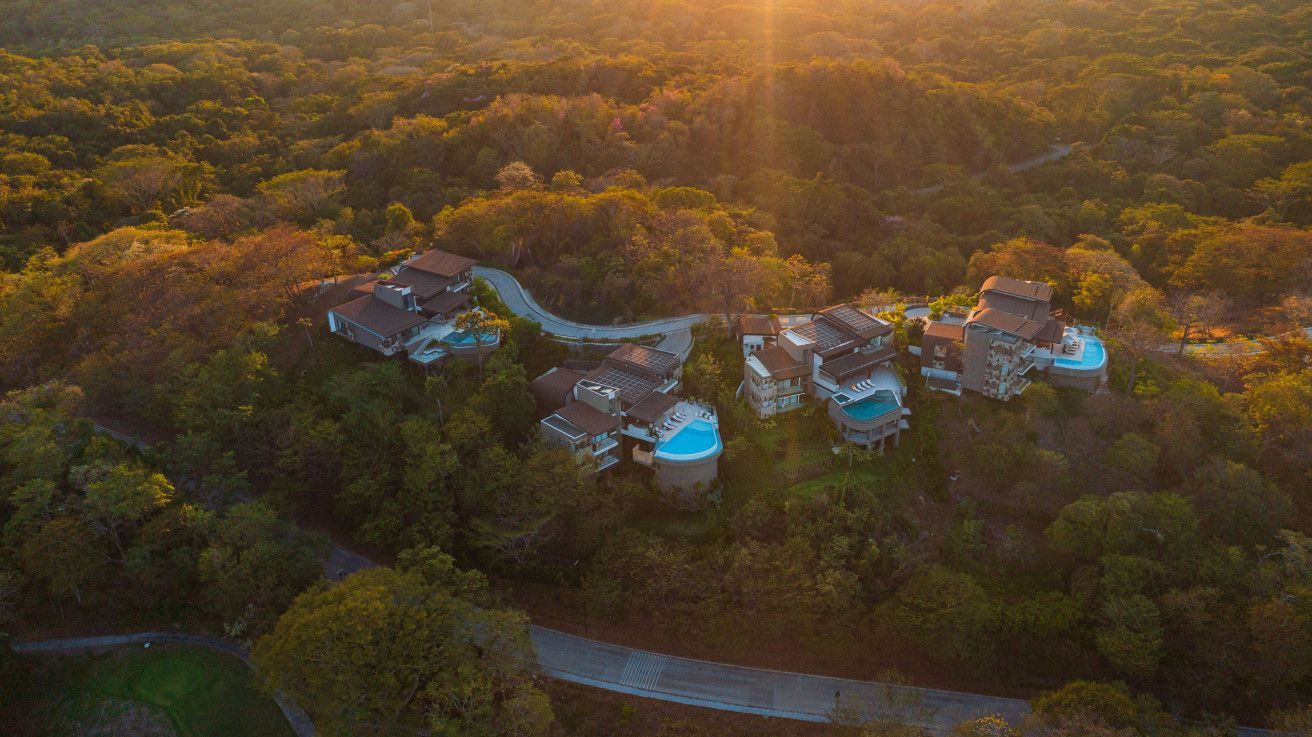
 Photo: W Costa Rica Residences, Guanacaste — Brand Atlas
11 September 2026 ·5 min read
Branded Residences in Costa Rica: Guanacaste, Conservation Land and the Wellness Premium

Costa Rica sells something most resort markets cannot: a coherent national story. Decades of conservation policy, a high share of renewable electricity generation and a wellness culture that predates the global trend give branded schemes here a narrative that does not have to be manufactured.
The buyer is overwhelmingly North American — a five-hour flight from most of the eastern United States, no time-zone adjustment, and a dollarised economy for major transactions.
Where the market actually is
- Papagayo Peninsula, Guanacaste — the concession-led anchor of the luxury market. Four Seasons, Andaz and the W Costa Rica reference point sit here, with the country's strongest branded-residence comparables.
- Guanacaste coast — Tamarindo, Las Catalinas, Flamingo, Nosara — the broader branded corridor. Nosara in particular has become a globally recognised wellness and surf market with genuine international buyer depth.
- Santa Teresa and the Nicoya Peninsula — design-led, wellness-heavy, difficult access, and consequently very high price per square metre for the product delivered.
- Central Pacific — Manuel Antonio, Jacó, Herradura — established tourism infrastructure, marina access, more mid-luxury than ultra-prime.
- Central Valley and San José — corporate and medical-tourism demand. Almost no branded residential, and limited near-term prospects.
Why the premium works in Guanacaste
Costa Rican branded premiums are earned on operational difficulty. Running a luxury property in a remote coastal location — staffing, supply chain, maintenance in a tropical climate, security, and rental management for an owner who visits six weeks a year — is genuinely hard. A resort operator with an existing base solves all of it at once.
The second driver is rental yield. Unlike most branded markets, Costa Rican buyers frequently underwrite the purchase partly on rental performance, and a resort-attached programme with real distribution materially outperforms independent short-let management.
| Segment | Typical positioning | Indicative premium vs comparable unbranded |
|---|---|---|
| Papagayo Peninsula | Resort-attached, concession land | 30-45% |
| Guanacaste coast (Nosara, Las Catalinas) | Resort and wellness-branded villas | 25-40% |
| Santa Teresa / Nicoya | Design and wellness-branded | 20-35% |
| Central Pacific | Resort-attached apartments | 15-25% |
| Central Valley | Urban serviced | 10-20% |
The regulatory reality: concessions, water and environmental permitting
- The Maritime Zone Law is the defining constraint. The first 50 metres from the high-tide line is public and cannot be built on. The next 150 metres is the restricted zone, held under municipal concession rather than freehold, with limits on foreign ownership of concession holders unless structured correctly and with finite renewable terms. Papagayo operates under its own special concession regime. Buyers, brands and lenders all treat concession structuring as a threshold issue.
- **Water availability (*disponibilidad de agua*) is the practical gating item.** In parts of Guanacaste, water letters are the scarce resource, not land. No water letter, no project — regardless of brand appetite.
- SETENA environmental permitting governs development approval, with timelines that international sponsors routinely underestimate. Coastal, forested and wetland-adjacent sites attract the most scrutiny.
- Freehold is otherwise straightforward. Outside the maritime zone, foreigners hold freehold title on the same terms as nationals, and corporate ownership structures are standard.
Which brands are actually transacting
Costa Rica is a resort-brand market, not a fashion-brand market. The buyer is purchasing an operating experience, and licences without an operating asset behind them do not clear. Four Seasons at Papagayo set the benchmark; Andaz, W, Auberge-style boutique operators and wellness-led brands such as Six Senses-type platforms are the active comparison set. One&Only's presence across Latin American resort markets has raised expectations further.
Wellness brands deserve particular attention here. In a market whose entire proposition is nature, longevity and health, a credible wellness operator can outperform a conventional luxury hotel brand on both premium and absorption — provided the programming is real and the facilities are funded.
What sponsors get wrong
- Buying land before securing water. The most expensive mistake in Guanacaste, and it is made repeatedly.
- Misunderstanding concession tenure. A concession is not freehold. It has a term, renewal conditions, municipal counterparty risk and ownership restrictions. Buyers will discount it if it is not explained clearly and structured properly.
- Underestimating tropical operating costs. Salt air, humidity and intense sun destroy specifications designed for Mediterranean conditions. Lifecycle reserve budgets are typically set too low.
- Overpromising rental yield. High season is reliable; the green season is not. Model annual occupancy conservatively and disclose the seasonality.
- Skipping the community question. Costa Rican municipalities and local communities have real influence over permitting. Schemes that treat the local relationship as a formality lose time.
The capital picture
Costa Rican resort development is funded largely by US and international private equity, family offices and specialist resort-development platforms, with local bank debt playing a secondary role. Dollar-denominated capital is standard for major transactions, which removes the currency friction present in most Latin American markets.
Institutional capital underwrites three things here: secure water and environmental permits, a concession structure that survives legal diligence, and an operator agreement where the residential fee load is proportionate to the service actually delivered. Schemes that arrive with all three closed raise money quickly; schemes missing any one of them do not raise at all.
Outlook to 2030
Expect Guanacaste to consolidate as the region's branded capital, with Liberia airport capacity as the key enabler. Expect wellness and longevity programming to move from amenity to anchor, with the residence product designed around it rather than beside it. And expect sustainability credentials to become a pricing factor rather than a marketing line — in this market, buyers actually check.
Costa Rica is not a volume market. It is a market where a small number of well-structured, well-operated schemes earn exceptional premiums because the alternative — managing a remote tropical luxury home alone — is genuinely unattractive.
Frequently Asked Questions
Can foreigners own branded residences in Costa Rica?
Yes, on freehold terms outside the maritime zone. Within the restricted 150-metre coastal zone, property is held under municipal concession rather than freehold, with foreign ownership limits on concession holders unless correctly structured. Papagayo operates under a separate concession regime.
Where are the best branded residences in Costa Rica?
The Papagayo Peninsula in Guanacaste has the strongest cluster and the deepest comparables, followed by the wider Guanacaste coast — Nosara, Las Catalinas, Flamingo — and design-led Santa Teresa on the Nicoya Peninsula.
What premium do branded residences achieve in Costa Rica?
Indicatively 20-40% over comparable unbranded stock, reaching the higher end at Papagayo and in resort-attached wellness schemes with a real rental programme. Operational difficulty in remote coastal locations is the main reason the premium is sustainable.
What is the biggest risk in a Costa Rican branded scheme?
Water availability and environmental permitting. In parts of Guanacaste, a water letter is harder to secure than land, and SETENA permitting timelines are routinely underestimated. Concession tenure structuring is the second major issue.
See also
Market guides by country
- 'The Future of Branded Residences' — Global Tour 2026
- Types of Branded Residences in 2026: Categories, Formats and Ownership Models
- Branded Residence Ownership Structures Explained: The 2026 Guide
- Hotel-Branded vs Design-Branded Residences: The 2026 Comparison
- What Are Branded Residences? 2026 Definition, Models and Market Size